A group, Peace Point Action, fishermen
and women, fish sellers, farmers, and youth groups have protested
against the alleged continued oil exploration and exploitation in Ibeno,
Akwa Ibom by ExxonMobil.
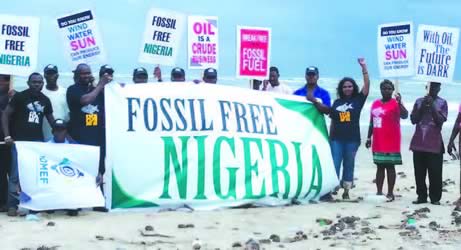
The protesters, who assembled at Ibeno
Beach beside the ExxonMobil headquarters in the state, asked the company
to seek for alternative energy source that is environmental friendly
and leave the oil and gas in the soil.
They expressed their grievances through
various descriptions on placards like, ‘Break free, leave the oil in the
soil’, ‘Oil is a crude business’, ‘If oil cannot promote our dignity,
leave it in the ground’, ‘Clean up Ibeno now’ and ‘Keep it in the
ground’.
Others are, ‘Thanks for the sad
memories, time to say goodbye’, ‘Oil destroys our planet’, ‘A world
without pollution’, ‘With oil, the future is dark’, ‘Oil brings death,
leave it in the ground’.
The group’s Executive Director, Umo
Isua-Ikoh, said Akwa Ibom, despite being the highest oil-producing state
in Nigeria has some of the worst social and economic indicators in
Ibeno and other oil producing communities.
According to him, the development shows
that oil wealth does not directly translate to wealth and sustainable
development for the people, but generates environmental disaster, time
bomb, poverty, disease and conflict.
“Our environment is our heritage. We
cannot continue to treat Niger Delta environment with impunity. That is
why we have gathered here on Saturday, to join concerned citizens all
over the world to say the time has come to end our fossil fuel
lifestyle, notwithstanding what ExxonMobil and all the oil
multinationals may think.
“If we are sincere about doing our part
to fight climate change, then we must leave the oil and gas in the soil.
The road to a cleaner, healthier and sustainable future has nothing to
do with coal, oil and gas. Nigeria has what it takes to invest in clean
energy,” Isua-Ikoh, said.
A fisherman, Nnimo Bassey, stated that
with whales dying one after the other, it meant that for every single
whale that died, thousands of other smaller fish might have died in the
ocean.
He stated that fish were nowhere near
the shore except deep in the Atlantic Ocean, and this, he noted, had
been problems to fishermen in the area.
He added that the shoreline and the rivers around oil producing communities had been polluted with fish dying in their millions.
Bassey maintained that many surviving
fish caught in such areas were so polluted that consuming them would be
like someone taking poison.
He said, “We need our environment so
that we can fish and farm. Water is not producing fish for us again and
our farmlands have also been destroyed as they have not been giving us
the necessary yield.”


No comments:
Post a Comment